 Eco123 Revista da Economia e Ecologia

 Just imagine if a fish were a tourist. He would bring money with him and spend it; he would consume local products, paying for his hotel and full board. But no, a fish is not a tourist: “what nonsense are you talking?” asks my flatmate, whom I told about my imagination at breakfast. A freshwater fish doesn’t need a freshly-made bed, but rather the bed of a clean stream filled with plenty of water, providing different places in its biotope where it can hide from herons and other dangers, such as water snakes and anglers. It needs currents, peace and quiet, sediment in the water, food and small animals. Do the fish in the Ribeira de Odelouca in the municipality of Silves have all this?
Sewage pipes that flow straight into the stream from the surrounding houses and water pipes and pumps are not what a fish needs. The cultivation of orange and avocado trees is also a disaster for the fish, as each tree takes water from the Odelouca stream for intensive irrigation. Furthermore, water must be at the right temperature and free of pig manure and other contaminants. How much water does a freshwater fish need to live well in a stream or river? I would like to discuss these questions with the Instituto de Conservação da Natureza e das Florestas (ICNF). But they’re not available for talking about that. It isn’t part of the project.
 Instead, ECO123 went to visit the Zoomarine amusement park in Guia near Albufeira, where native fish are also bred in aquariums to protect them from extinction. There is a reason why the freshwater fish with the Latin name Squalius Aradensis became extinct in the Odelouca stream, and efforts are now being made to reintroduce the fish there. This cannot be done without change and it requires Águas do Algarve S.A. to release much more water from the dam in order to provide a safe biotope for the twenty fish that have been released into the stream, thus giving them a better chance of survival. This also requires agriculture to reduce the amount of water it extracts from the stream. Every house takes as much water as it needs from the Odelouca stream to irrigate its trees – today, the former river is only a trickle and, in the summer, its bed frequently dries up at various points.
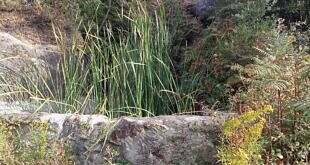
‘There is no serious higher authority in Portugal that has any real power to issue directives and control what is happening with the Arade and the Odelouca.’ This is what ECO123 frequently hears from farmers. Invasive plants are growing uncontrollably on the banks of the streams, drinking up the last of the water: reeds and pampas grass, which are not native to Portugal and are multiplying uncontrollably. ‘There is the ICNF, but what is this institution supposed to control other than itself?’
The stream doesn’t carry enough water. That is a fact; but it is also a matter of opinion. Because the river is being dammed and millions of cubic metres of water are being extracted by a company in which all of the region’s 16 municipalities are shareholders. What is ‘enough’ and what is ‘too much’? How many conflicts of interest are there in the Algarve and its water supply? Interventions in nature must not be allowed to degenerate into self-service operations, like in a supermarket, but without using any cash register. If there are no laws governing such interventions, then the appropriate laws must be made and strictly controlled by the legislator. Águas do Algarve, the water company that supplies Portugal’s southernmost province, seems omnipotent and can take as much water as it likes from the region’s streams, damming the Odelouca stream and diverting the water away for its own purposes. And how much water is left in the former river (and present-day stream) for the inhabitants and farmers in the region? How much water will the twenty fish that were released into the stream last month eventually have to make do with?
ECO123 spoke to Sófia Bach, the press officer at Zoomarine, and marine biologist Isabel Gaspar, who is responsible for the rehabilitation and conservation of marine animals at Zoomarine. Zoomarine also has a department where endangered aquatic animals such as fish and turtles etc. are saved from extinction. ‘Together We Protect’ is the name of the department, which also raises awareness among schoolchildren in the Algarve about such environmental questions. But if a species of fish that has become extinct is being carefully reintroduced, shouldn’t care also be taken to ensure that the biotope has a minimum amount of clean water and that this subject is discussed with the inhabitants and farmers of the region beforehand? Shouldn’t there be some active communication taking place about this?
ECO123: “If you and two other partners are releasing twenty freshwater fish into the Odelouca stream, how many fish do you expect to count next year? What do you consider will be your success rate? Due to the dam, the river has 80% less water than it previously had and has now shrunk to the size of a stream. There are also anglers at work, as well as many other enemies of the fish: herons, water snakes …
Isabel Gaspar: We don’t know the answer to your question. These fish lived with us in a protected aquarium. The release of twenty freshwater fish into the Odelouca stream is an attempt to reintroduce this particular species here. These fish are not attractive to anglers. They are small and only 15 cm long. And there is hardly anything to them. It is a symbolic measure. Normally, between 500 and 600 fish are released in such an operation. It is an experiment.
ECO123: Is there any monitoring?
Sófia Bach: Zoomarine is not responsible for monitoring the operation. That’s why we launched the project with two other partners. Quercus and Águas do Algarve are excellent organisations for monitoring this event.
ECO123: One cubic metre of water costs half a euro at Águas do Algarve. In an emergency, will your partner open the dam and release water if the stream dries up and the fish are in danger of dying?
Isabel Gaspar: You’ll have to ask Águas do Algarve. We are responsible for breeding the species in our aquariums. The monitoring operations measure the water level and the quality of the water in the stream. There is also the ICNF, which is responsible for the protection of nature. We have signed a protocol, and this establishes clear responsibilities – including our partners doing their work.
 Doesn’t a biotope have to be carefully prepared before twenty freshwater fish are released into it? If there isn’t enough water in the Ribeira de Odelouca, then you can’t release any fish there because the stream would soon run dry. How is the monitoring of freshwater fish organised? For ECO123, the three partners’ project is beginning to look increasingly dubious. Is it really just about obtaining good press, or have they carefully examined the conditions under which the young freshwater fish will be able to live in the Ribeira de Odelouca from July 2025 onwards? We’ll continue this story next week. We will report on the project that has already spent three years preparing for the release of native freshwater fish into the Ribeira de Odelouca near Silves (Algarve) …