 Eco123 Revista da Economia e Ecologia

I’m no know-it-all, but, in this article, I’ll be taking the liberty of speaking freely about ideas, rather than succumbing to a sense of powerlessness. Because unleashing the potential of a truly united Europe requires bold, unconventional ideas. We simply need to be able to say what we think, what we’re worried about, and what solutions we propose.
For example, I sometimes imagine that the district of Monchique doesn’t belong to Portugal, but to Germany, England, Luxembourg, Sweden, Finland or the Netherlands…
What would be different about European politics then? Which issues would be given absolute priority? How would the people living in Monchique interact with one another? How would politicians respond to the threat of future forest fires? Before the last major forest fire in 2018, the magazine ECO123 organised a workshop in Alferce, asking: “How would you like to live in Monchique in the future?” Around 50 readers took part in this workshop, and seven working groups were formed to focus on key areas. Over two days, they discussed the wishes, dreams and visions of the people of Monchique on topics such as nature, the economy, transport, food, housing and much more. But then the forest fire took away their motivation…
 However, I should like now to revisit a question from that workshop: how would politicians respond to the threat of new forest fires if Monchique were not part of Portugal, but were, for example, a municipality in another northern European country? In Germany, for instance, every local council would have set itself the goal of doing everything in its power to ensure that there are no more forest fires. There are no ‘woulds’ here, though! Anyone who has ever burnt their hand on a hot stove knows that they will never touch one again without wearing protective gloves.
Here in Monchique, it is with fear, sadness and horror that we look back over at least six major forest fires in the last 35 years. A whole generation have spent their entire lives under the permanent threat of forest fires, which recur every few years. The result has been a huge deterioration in their quality of life and a dreadful loss of potential wealth. Many people have become victims, even though they themselves have done nothing to cause a forest fire. And then there are others: those who have simply cleared away their native oak and chestnut forests and instead planted eucalyptus stands that stretch for miles, making a lot of money from this process. Yet others have abandoned their monocultures and left them exposed to the devices of nature. When such plantations inevitably catch fire, they reach temperatures which are so high that no firefighter can possibly withstand them. The fire then destroys their neighbours’ homes and possessions, while also killing animals and plants. All that remains thereafter is ash, and, after the first winter rain, this ash is washed into the streams and springs, contaminating the drinking water to boot.
Contamination can also affect the brain. There are many who believe there is nothing that can be done about forest fires, that they cannot be prevented, and that they are simply part of life in Portugal. I should like to ask them when they last had themselves tested. Examined for their state of mind, their mental condition, their sanity! I’m just trying to imagine a German district being ravaged by forest fires several times within a single generation. After the second forest fire, the mayor of the municipality would not only have been voted out of office, but sent into the fire himself, consigned to hell, along with the town council’s employees.

How about making a pledge at the inauguration after an election? When taking up his new post, could a mayor not be obliged to swear on oath that he will do everything in his power to ensure there are no more wildfires in his municipality? He could, for example, ban the planting of eucalyptus trees within a ten-kilometre radius of the municipality. Eucalyptus is a very dangerous, water-intensive tree. Wherever it is planted, streams dry up, the level of the water table falls, and biodiversity – the range of different species existing in the local flora and fauna – declines. Furthermore, it is also invasive, a fact that both the paper industry and the ICNF, the Institute for Nature Conservation and Forests, repeatedly deny. When I fell a eucalyptus, it immediately begins to sprout again in order to regrow. There are even worse trees, the true invaders, which not only immediately resprout but multiply a hundredfold: mimosa and acacia, growing as pioneer plants after every forest fire in Portugal. The ICNF has made no inventory of the situation in the last ten years, even though it is legally obliged to do so every five years. One might assume that the ICNF is an agency staffed entirely by Australians, because it prefers to introduce Australian tree species rather than look after the native ones: cork oaks, chestnut trees and all the many native species that belong to Portugal and which also fall victim to the forest fires. But perhaps the ICNF and the paper industry are working together? Perhaps the Portuguese forest doesn’t need an authority to look after it at all? We could just let the paper industry do the job. That would save a lot of money on an authority that doesn’t display any responsibility for contributing to safety in the native forest and for protecting those communities that live in a natural environment. And so forest fires in Monchique and elsewhere continue to be inevitable in the future.
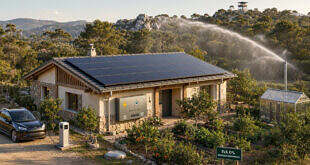
Unless, of course, we were to “clear the decks” and finally tidy up the forest. There is a total area of 92,000 km² in Portugal, with around 10,000 km² of eucalyptus plantagens, which means that it is more than ten per cent of the country’s total area. Around 320 km² of Monchique’s 397 km² are similarly infested with eucalyptus monocultures. Reducing the risk of forest fires means banishing eucalyptus from the vicinity of villages and towns – from the vicinity of people – and limiting it to a minimum. Eucalyptus, mimosa and acacia must be cleared away and replaced with native tree species immediately afterwards. Cork oaks, olive trees and carob trees are notable for being frugal in terms of their water consumption. Moreover, sprinkler systems already exist that can protect entire forests and many local communities from wildfires. Guaranteeing its citizens a life free from wildfires is an item that must surely be included in every ‘to-do list’ of a nature-friendly local authority and its mayor. The inhabitants of the Portuguese countryside are entitled to see the return of a future worth living to their villages. Instead of losers, we need winners, and their stories…