 Eco123 Revista da Economia e Ecologia

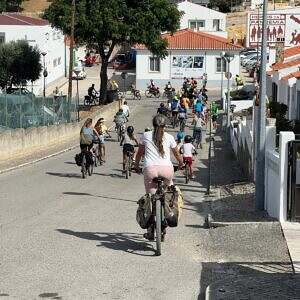 Last Saturday, 27 September, at 11 a.m., around 60 cyclists and their children gathered in Aljezur’s church square to draw attention to a traffic problem in the municipality that has remained unresolved for many years. National Road 120 runs through the town of Aljezur, and, whether it’s cars or lorries, buses or tractors, tourists or locals, all traffic has to flow through this bottleneck at the weekly market: including cyclists, who often find themselves in trouble because there are no bike lanes – neither for adults nor for children. When the bicycle parade set off from the new part of Aljezur, Mayor José Goncalves was also there to see the group off. ECO123 discovered that José Goncalves cannot ride a bicycle at all, so he was left behind, astonished and alone at the side of the road.
 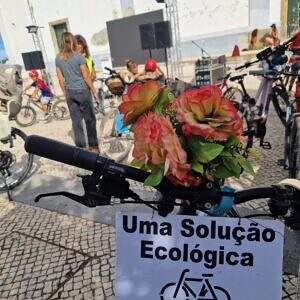 This may explain why the mayor has so far refrained from implementing a solution, even though citizens have already submitted a wide range of proposals. Their applications were simply not processed by the town hall. One can also decline the proposals of concerned citizens by simply ignoring their written suggestions.
But there will be new elections in October. Voters can express their confidence in their mayor – or not. They can simply vote him out or let him continue. That’s the nature of democracy. People are free and spoiled for choice.


The cyclists rode about nine kilometres from the fire station to the beach at Amoreiras. This is precisely the route that is being discussed for the creation of a cycle path. It’s a first step in the right direction. However, there are also other cycle paths that cyclists in Aljezur would like to see. Incidentally, they had to take care of their own traffic safety by themselves, as the GNR decided to remain discreet and conspicuous by its absence. As ECO123 learned from the organisers, this bike tour will be repeated in May 2026. It is entitled “Kidical Mass” …