 Eco123 Revista da Economia e Ecologia

What is more important in life and what comes first: earning a lot of money or learning to take responsibility? Let me tell you a story.
Last Sunday, at ten o’clock in the morning, everything was still fine: in Aljezur, in Lagos, and also on the hills in between. That was when Carlos* picked up the phone and called the civil defence authorities to inform them that he was going to set fire to the green waste and finally burn all the rubbish on his property. It was 21 September. According to the calendar, Summer had come to an end; Autumn had begun.
The voice on the other end of the line warned Carlos that it wasn’t a particularly smart idea to light a fire at that moment, as the landscape was very dry at the end of summer and the wind wasn’t helping either, with a strong breeze blowing in from the Atlantic, coming from the north-west and set to get even stronger after midday. And what did Carlos reply to the civil defence authorities? The land was his property, and it was he who would decide what happened on it. Then, at 12 noon, he set fire to the pile of brushwood and leaves, dry grass and branches. We know all about the rest of the story from the daily press, which unfortunately did not report how and why this forest fire actually started. One would have expected the civil defence services to show more social intelligence in communicating with a citizen.
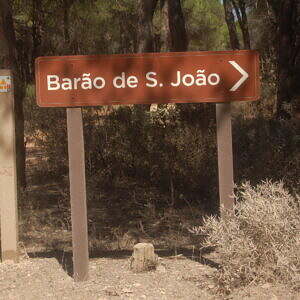 The question that now arises for me is this: why did the civil defence not immediately inform the police about this call, and why did the GNR not immediately respond and intervene to arrest the arsonist? The fire raged for four days between Bordeira, a municipality south of Aljezur and Lagos, setting fire to the forest known as ‘Mata Nacional de Barão de São João’ with its one million umbrella pines, officially protected since 1944. Carlos’s fire naturally raged out of control, as was to be expected. His second call to the civil defence was more subdued when he asked for their help – too late.
I am familiar with destruction. I live and work in Monchique. Since 1991, five devastating forest fires have left a ravaged landscape in their wake: in 2003, 2004, 2016 and 2018, with other fires also breaking out here and there in between. And no one here in Monchique has unconditionally and extensively reforested the area. I can now take stock of the forest fires in this region, because I have been living and working here for a very long time. A destroyed forest area is always an opportunity for a new beginning. Undoubtedly, the sometimes ‘useless’ ICNF (Institute for Nature Conservation and Forests) already has an idea of how to plant a variety of trees that will be tolerable for everyone used to working with a monoculture. Or, if that is too much work for them, they can sell the state-owned land of the burnt forest to the Navigator paper company. They will certainly have an industrial use for it: planting eucalyptus for paper production. And perhaps the ICNF can be persuaded to do so with a little bribe…
But anyone who is up to date knows full well that diversity (biodiversity) is the only solution that can be implemented after a disastrous forest fire. Deciding whether to plant monocultures of pine or eucalyptus or a mixed forest of different tree species native to the Algarve, in which a new biotope of flora and fauna can develop, represents a very special challenge to the intelligence of a country, to the intelligence of a society and its culture – as well as for our children and future generations.


It all depends on what is more important to you: making money or deciding whether Portugal is ready and able to take responsibility. Here, a country can prove that ‘environmental education’ is not just empty talk, but that it means planting a new forest with all the work that this entails. And a new beginning always means starting from the ruins that Carlos is responsible for with his recklessness. He should be punished legally for this, and the state should show him what it means to lose everything: his property and a life of dignity and health, which has been permanently destroyed by such a fire.

I am a foreigner and come from Germany. I know what it means to have been born in a country that was destroyed by bombs, and I know all about the suffering that war causes. That was why I left Germany, because you cannot choose the country you are born into. That is also why I have been able to experience what it means to grow up in a community of states, working together with others to build and preserve a new Europe. A burnt-down forest is a very sad affair – but, in my opinion, it is also an opportunity to rebuild something that could be much better. Let us turn a monoculture into a diverse forest. Let us help each other: let us work together to protect the new mixed forest against the new and acute dangers of climate change. This will require at least a ten-year plan. But it is a challenge! Let us shape the future – now – and leave the unspeakable sadness behind us.
* Name changed