 Eco123 Revista da Economia e Ecologia

By Theobald Tiger
How do we communicate in times of crisis? Do you also believe that we should call the fire brigade when the forest is on fire, or call the bank when we run out of money? Those who consider the division of labour to be the pinnacle in modern communication in the event of a disaster may, like the people of Leiria, spend weeks waiting for the men from e-redes, who really have nothing else to do but turn the electricity back on after four weeks of rain and storms. REN (Rede de Eletricidade Nacional) has just taken out a loan of €300 million to be repaid over eight years at an interest rate of 3.42%. We really have no idea what may lie ahead of us when we face climate change head-on. There will be an increase in forest fires and storms, while water levels will rise. Houses will disappear into the water, roads and electricity pylons will vanish, as well as people and animals, too. Crisis upon crisis. What do we see over there? The carnival clown engaging in foolish revelry? What colour is the eye of the storm? Blue, green or yellow?

When thousands of people experience a power outage at the same time, with high-voltage pylons collapsing like matchsticks and power lines carrying several hundred thousand volts touching the ground and water, the men from e-redes have nothing less to do than to attempt to square the circle. What to do when you run out of money? In my case, only the fuse box blew, and, after I’d waited for some hours for the men from e-redes to come, it was replaced in three simple steps. I had to support the man on his ladder, otherwise he would have been blown away in the storm. It must have looked funny, but it was necessary. Have you noticed how powerful thunderstorms are in these times of climate change? Lightning and thunder like to strike the high-voltage pylons of the electricity suppliers because they stand like antennas in the landscape. And lightning loves antennas…
Overwhelmed everywhere? I was able to listen to music for an hour at 800 506 506, which e-redes offered to customers for meditation, because when thousands of customers call the emergency services at the same time, the telephone system completely breaks down. In times of crisis, I think that classical music is preferable for meditation. Do you see where I’m going with this? How do we communicate in times of crisis? And how do we react?
 Whether we like it or not, from now on we will have to get used to enduring weeks of rain and storms with familiar names from the alphabet (Kristin, Leonardo, etc.) in winter and forest fires in summer. Chaos. Nice prospects, aren’t they? So it’s fitting that we can now ignore climate change and actually sing its praises, just as the 79-year-old shepherd of the United States does for his flock. Look away, duck away, block out what cannot be, as it doesn’t even exist. That’s one way to do it…
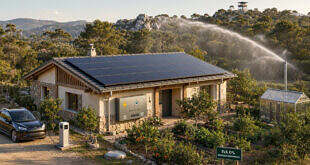
I tend to side with physics, even though I hated the subject at school and only received bad marks. But I wrote down the word RESILIENCE and put a little note in my pocket. The word resilience has accompanied me through my life ever since then. Right now, I am deciding how I will use my 20 solar panels in the future. Will I continue to feed electricity into a dilapidated network, or will I make better use of the clean energy myself? Making myself truly resilient. When I talk to people about emergency measures, I realise that Portugal is not prepared for climate change. And those who trust the electricity suppliers to solve the climate crisis and find concrete answers to urgent questions will be left without answers and, in the worst-case scenario, without electricity altogether. And what do we do in the event of forest fires?


I have installed a sprinkler system to combat forest fires in my forest (https://www.wetnet.pt/en). I cannot trust e-redes to supply me with electricity in the event of a forest fire, because my experience is that the public power grid is the first thing to collapse when the forest is ablaze. So, the question that I have asked has already been answered. Resilience means having your own emergency power supply in the event of a catastrophe, like a hospital. Self-help is perhaps the simplest answer. Much better than calling e-redes in the event of a forest fire is learning to communicate well with your own trees. What do I mean by this? I recommend the TED Talk by botany professor Suzanne Simard as an introduction to this topic:
https://www.ted.com/talks/suzanne_simard_how_trees_talk_to_each_other