 Eco123 Revista da Economia e Ecologia

I almost didn’t notice it. I was searching through my emails for that thing about the petitions, and suddenly I had two petitions in front of me – both dealing with the subject of happiness. At first, I thought they were one and the same petition. A brilliant trick. But then I saw the difference. One was a PR piece about happy dairy cows, and this information came from the Azores archipelago, from the island of São Miguel, and from the Bel company, which I already reported on last week. I was told that the cows in the Azores are the happiest in the world. Congratulations. That is, of course, very good news. It has something to do with the fact that they graze outdoors in the fresh air all day long. And then I thought about people who might be out in the fresh air all day long. How happy they should be…

I can’t imagine that at all. It must rain sometimes in the Azores. And if it rains, cows get pretty wet while they’re grazing. I, for one, feel quite uncomfortable when I have to eat my breakfast outside in the rain. And then lunch and dinner too? It’s impossible for me to be happy there. But we shouldn’t judge humans by comparing them to cows. Maybe cows really do feel comfortable out there in the fresh air. Of course, from time to time the sun does, in fact, shine in the Azores. But even when it’s sunny, I don’t always like being out in the fresh air. Sometimes I’d rather be in my barn. At least there’s some shade there…
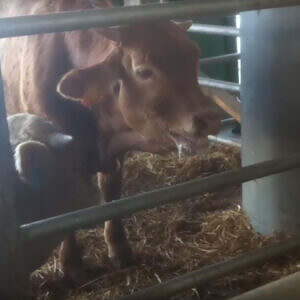 And then the second text. It comes from PATAV and it’s a petition that tells us about the condition of some rather unfortunate cows. Because there are also cows that are used in a cruel business. They are led and loaded onto ships, like Moses leading his people into the desert. Then, sooner or later, these ships set sail and navigate their way to Israel. There, the animals are unloaded half dead and eaten kosher. Hallelujah?
Who is PATAV, you may ask? And what happens to the cows that die at sea? Are they thrown overboard and given a sailor’s burial? Because this living cargo will at least get seasick, if not mortally ill, from a crossing that can last two to three weeks without food or drink. These voyages have already been banned in the United Kingdom. And PATAV is, well, what is PATAV? I look at this email and I can’t figure out what PATAV stands for. The sender has either forgotten or deliberately omitted to tell me exactly who he is and where he lives. There are only two names and telephone numbers, so I try Hugo Evangelista and Isabel Carmo and learn that PATAV stands for ‘Plataforma Anti-Transporte de Animais Vivos’ (Platform Against the Transport of Live Animals). An association? A loose group of friends? What is behind it? It doesn’t matter. They have collected 9,000 signatures and want to hand them over to the Deputy President of Parliament. Will this help to make these poor unfortunate stowaways happier? When they arrive in Tel Aviv after several days without food or water, completely dehydrated, and are then unloaded once more. https://patav.weebly.com/

Why do Israelis have to eat beef? And kosher beef at that! They should follow the example of the Palestinians and fast. But that’s how life is. Unhappy people who have been suffering from post-traumatic stress disorder ever since 1945 now have to pass it on to other people and animals from the next generation in 2025. Shouldn’t we here in Portugal stop transporting animals to Israel? Is it just because we earn a little money from the poor animals? The Israelis could also adopt a vegetarian diet, couldn’t they? There are many other areas of business in which we Portuguese could become active. I reserve the right to perhaps bother you with this subject again next week, as I have already clearly exceeded my 500 words in this column. Now it’s time to stop the satire and get serious again.