 Eco123 Revista da Economia e Ecologia

Anyone who, like us in Portugal, is currently aware of the foul smell and plumes of smoke originating from the forest fires in Alberta and Saskatchewan in Canada knows that the weather that is experienced on one side of the Atlantic Ocean can have a profound effect on the other side of the world. Just google Saskatchewan. Then you’ll see how far away the forest fires are from Portugal, and from Europe. And yet we are currently breathing the air from the scorched forests of North America on a daily basis, as if the forest fires were taking place in a neighbouring region of the Alentejo.
We must realise that forest fires are not isolated local events: they must be understood as being perfectly capable of crossing international borders and thus having a global impact. For this reason, not only should we be on high alert worldwide, but the goal of fire prevention should be placed at the heart of any environmental policy and crisis intervention. How can this be done? Fire prevention is not a local task: it starts on your own doorstep. When a forest fire is out of control, this only means that citizens, civil defence teams, fire departments and politicians have given up the fight and lost the battle. In other words, the tasks that they have to perform are greater than the state institutions can deal with.
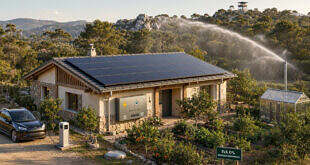
When wooden houses catch fire next to pick-up trucks, when forests burn to the ground, when all attempts to extinguish a forest fire are no longer capable of containing it, then something is fundamentally wrong in life and in crisis intervention. Anyone who flees or is evacuated from such situations would be better off moving to the city now and turning their backs on nature. Because concrete doesn’t burn. In nature, on the other hand, what is needed is people who are prepared to fight under all circumstances and are only satisfied when the fourth element of nature, fire, has been extinguished. But it would be even better if there were no fire burning in the first place. How do we achieve this?
 It is perfectly legitimate to ask what causes forest fires. The number one cause of forest fires is human negligence. People often have very poor self-awareness. They light a fire to burn the remains of nature instead of turning these green remains into mulch. Then the wind gets up and fans the fire, which thus gains strength until suddenly it is out of control. Or perhaps a eucalyptus tree sways and hits a high-voltage power line, causing sparks to fly. Or simply a carelessly discarded cigarette end can cause a fire. Even a carelessly discarded glass bottle can cause a forest fire by acting like a magnifying glass. Carelessness is the enemy of mindfulness. It starts with awareness training at school and at home. The learning goal is this: how do I avoid forest fires? Would you like to tell us something about this?
Number two in the statistics relating to the main causes of forest fires is the intention to start a forest fire. Someone goes into the forest with the aim of setting it alight. How should a society deal with a potential arsonist? Are you in favour of a convicted arsonist being given a minimum prison sentence of five years or more? Would you like to tell us something about this?
ECO123 will be paying special attention to the topic of forest fires throughout the summer of 2025. In reports and interviews, we will be addressing the subject of the fourth element, fire. The forest must not burn, not least because it converts CO2 into oxygen. Forests are living organisms and need our special protection. Would you like to tell us something about this?
Write an email to ECO123 with your ideas and suggestions:
theobald.tiger8550@gmail.com