 Eco123 Revista da Economia e Ecologia

As our global tree population dwindles at an alarming rate due to forest fires, industrial use and deforestation, the use of information technology is increasing at a reciprocal rate. Children are beginning to use such technology at a very early age, mostly at school and during leisure time, and this process seems irreversible. Are smartphones, laptops and computers merely a means to an end? Something is wrong with the narrative of modern human life. We are moving further and further away from nature. We are alienating ourselves. But where are we actually heading?
 At the same speed at which we are turning to artificial intelligence and making humanity superfluous, our numbers are multiplying exponentially, and we now have a world population that is heading towards ten billion people. That’s contradictory, isn’t it? Because if we make the artificial intelligence provided by information technology our ‘tool’, we don’t need nine out of ten people. So, shall we do away with them?
Children, teenagers and adults who can happily use their ten fingers to operate a computer keyboard are unable to perform a completely normal activity (let’s stick with the forest as our example): they are unable to plant a tree because they lack the knowledge, experience and even the imagination to do so. And even if artificial intelligence promises us that it can build a robot that plants trees for us humans, I frequently wonder: what for and why? What is the point of that? Can artificial intelligence feel something like happiness? The happiness I feel when I nurture a tree over the first few years of its life and notice how well it is doing and how much shade it provides me with.
 If we continue to distance ourselves from nature and do not know what the goal of our endeavours is, that is to say, we do not know where we want to go and will go with artificial intelligence, then it would do us good to stop for a moment, take a deep breath and think about where this path might lead. And what alternative paths do we still have that will lead us away from artificial intelligence? I suggest pausing for a while and figuring out who we want to be and where we are striving to go.
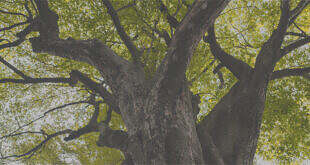
I recently took advantage of a short break and stepped into the shade of my largest umbrella pine tree with a thermometer. The temperature there was 28º Celsius. Then I stepped out of the shade of the same umbrella pine tree into the blazing sunlight, and the thermometer soared to 39º. For the sake of completeness, I’ll tell you the date. It was Sunday 17 August at 4 p.m. 39º Celsius without the shade of a tree means fever. And now I ask you: what is more important: a smartphone or a tree?
 ECO123 does not have enough water of its own in its fledgling botanical forest garden in summer, but in winter we have more than enough. What can we do to solve the problem? A gardener I talk to recently asked me how I water the trees, and I explained my method to him. Tree-to-tree watering, performed manually with a hose. In summer, I use the public water supply – in winter, I use water from our own springs. This costs us several thousand euros every summer. I’m talking about 150,000 litres of water, which have been missing since the big forest fires. For 20 years now – since climate change began – the springs and wells have been providing far less water than before.
“Use less water,” this was his good argument. Use an irrigation system that introduces drip irrigation. So, what should I do? Buy plastic hoses and connect them together? Didn’t we want to banish all plastic from our lives? Isn’t plastic made from crude oil, gas and coal? And if a hose breaks, we end up with hazardous waste. Where do we put this hose? Do I recycle it? There is no recycling for these plastic hoses. Or is there?
 I have decided to carefully divert and collect some of the water in winter and store it in a large cistern for the summer, so that we can water our trees with the winter water in summer. Young trees, such as lime, beech, oak and many other undemanding native species, need very little water. Carob trees also need very little water, as do fig, walnut, pomegranate and olive trees, and there are even some trees that can survive up to 150 dry days without rain (cedars and cypresses)
Unlike some tropical fruit trees, such as mango, avocado and banana, etc., the frugal species mentioned at the beginning hardly need to be watered once they have reached the age of an adult tree. Problem solved? It is important to have planted a tree in your life and to have watched it grow. I cannot use a smartphone or computer for this, because this experience isn’t part of virtual life. Only then will I know how to protect myself in the forest from fever, drought, rain and artificial stupidity.
Recently, a fellow journalist wrote in his daily newspaper about someone who tried to climb a very high mountain peak wearing trainers. He had an app on his smartphone that described the best way up and down and gave him the weather forecast. The mountaineer had to be rescued by helicopter because he was wearing the wrong clothing and footwear and had strayed from the right path.