 Eco123 Revista da Economia e Ecologia


Banks can generally be criticised for many things when they lure customers with their money and give them loans, and the European Investment Bank (EIB) in Luxembourg is certainly no exception. Exactly one hundred years ago, one of my famous role models in journalism, the German Kurt Tucholsky (alias Theobald Tiger, alias Peter Panter, alias Ignaz Wrobel) stated in the Berlin weekly magazine ‘Die Weltbühne’ of the Weimar Republic that a bank manager’s vision extended only as far as the tip of his own nose… (Then came the National Socialists)
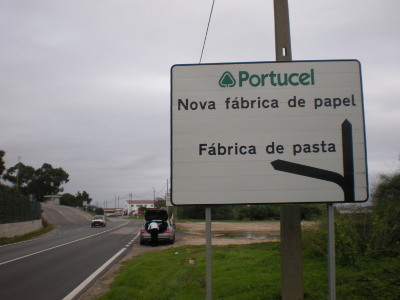
 ..and this goes hand in hand with the criticism we may make of the Portuguese wood processing company ‘The Navigator Company SA’ (alias, before its name change, Portucel, Soporcel, etc.), namely that it is not worthy of a loan of 115 million euros in European funding for its factory in Sétubal and another 40 million euros for its factory in Aveiro. The EIB’s reasoning: it is being supported with EU funds because its paper mills are due to become CO2-neutral in 2035, 15 years ahead of the deadline set by the EU Commission for 2050…
Am I entitled to judge, question or cast doubt on something like this? Is a journalist allowed to have an opinion and express it, especially when it is well-founded? Well, yes, if it is a commentary and not a report or an article. So, honourable prosecutors and judges, please do not take offence and consider my words as a commentary or simply an expression of my opinion. Because, as a journalist, I am now under legal observation in Portugal. Last Wednesday, the GNR in Monchique informed me that I had been reported by the Navigator company for defamation and libel. I am now an ‘arguido’ and must pre-register any travel that I may be thinking of making. I have nothing to say about the allegations. Readers may form their own opinion. If the Portimão public prosecutor’s office considers the criminal complaint to be justified, charges will be brought against me. Then I may be convicted. But perhaps not. There is such a thing as freedom of the press, even in Portugal.
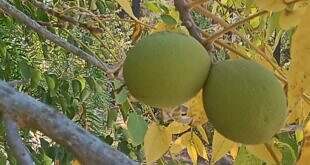
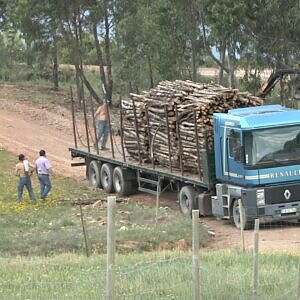
 Because I write regularly about the forest and the Navigator Company, and I am a thorn in their side. Because we publish in multiple languages. And I don’t do my research from my desk; I go out into nature, into the forest, into the woods. So you can read ECO123 in Brussels, Germany, Ireland and even Luxembourg. To be clear: it is the Navigator Company that grows this deadly drug known as ‘eucalyptus’ in its nurseries and then markets it commercially, selling it to farmers and forest owners, and not without some success. For the traditional mixed forest – a modest mixture of cork oak, chestnut, ash, alder, carob, almond and olive, as well as many other native Portuguese tree species – has been uprooted during the time I have spent observing Portugal as a journalist and has been replaced with the water-guzzling eucalyptus tree from Australia. A foreign ‘drug’ that, when felled with a chainsaw after eight years of growth and processed into paper at the Navigator factory, simply conjures up (or expels) a new trunk from the stump. That’s why eucalyptus is such a miracle drug; it sprouts again on its own, so you don’t have to get your hands dirty or invest new money in a new tree. It all happens by itself – seemingly magically.
As a journalist, I have been hiking through this region for many years. When you roam the countryside on foot, you experience reality up close. Take the Via Algarviana, for example. I noticed very clearly why, for example, there was only one fire in the municipality of São Bras de Alportel between 2007 and 2025 – in 2012. And there have been no more since then. If you start to walk the Via Algarviana at Alcoutim on the banks of the River Guadiana and head for Alte, you will travel a distance of 150 kilometres through a region that is free of eucalyptus trees. The mayors and the populations of that region reject eucalyptus monocultures. From Silves onwards, however, the industrial plantations begin, and anyone who climbs up to Monchique in the mountains is moving in dangerous terrain, at least in summer, when it is hot and dry. Here, the eucalyptus plantations often burn fiercely, in 2003, 2004, 2016, 2018, 2023 … In Monchique, the forest owners are addicted. Because there is a lot of money at stake.
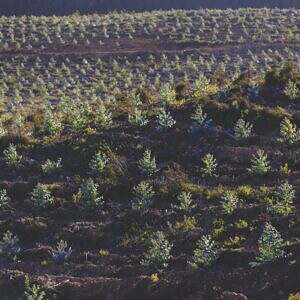 This makes it very easy for the so-called drug dealers of The Navigator Company to sell their goods to addicts. And, as we all know, everyone wants to make money: the forest owners with their plots of land and woodland, The Navigator Company, of course, the loggers, most of whom come from Brazil, Ukraine or Romania. Making money is like an addiction. It always has to be more and more and more and more. No matter how? Where eucalyptus once stood, no other tree species will grow for a long time. The soil is depleted, grey and dried up. I have seen this with my own eyes as a journalist: since 2018,
 our cooperative has been running this newspaper and also creating a botanical forest garden: an oasis in the eucalyptus desert. We are pulling out the roots of formerly planted eucalyptus trees and planting more than a hundred different native tree species, including the Monchique oak, of which there are only four trees still remaining in the municipality of Monchique. And we are adding plenty of goat manure and mulch to the furrows, providing natural fertiliser for the young trees.
Portugal is the only country in the world where 98% of the forest is privately owned and only 2% belongs to the state. This explains why 10,000 km² of Portugal’s land area, which covers 92,000 km² on the Iberian Peninsula, was plastered with ‘environmentally toxic’ eucalyptus trees between 1990 and 2015, precisely during my generation. That is more than ten percent of the country’s territory. The government does not draw the boundaries; it lets the market draw them instead. If the forest is merely a commercial commodity, should it be managed like a sausage factory? Doesn’t the forest also have a much deeper meaning, an aura of magic and health? Isn’t the forest also a nesting place for birds, and don’t flora and fauna belong together? Does the market have the right to cut down trees every eight years just to make paper? Do the laws protecting nature no longer apply?
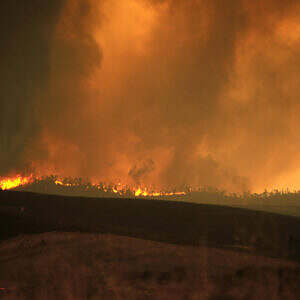
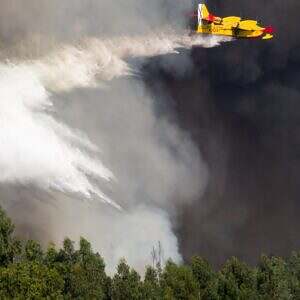
Do you have any questions so far? You probably want to know why Portugal experiences such incredible forest fires every year, which cannot be extinguished. According to the fire brigade in Monchique, where more than 75 per cent of the forest is planted with eucalyptus trees, the resulting monoculture becomes an industrial forest and burns like petrol; it is almost impossible to extinguish. More than 300 km² of the Monchique district, with a total area of 397.5 km², are classified as highly flammable. So, I live and work in a powder keg. And the EIB bank director talks about climate-neutral working and manufacturing in Navigator’s factories, when all around us these monocultures are burning brightly every year. Shouldn’t Navigator be held accountable and liable for the material damage caused by forest fires? Just one single km² of forest that goes up in smoke emits 20,000 tonnes of CO2. These figures come from the UN, and, as we know, the Secretary-General is Portuguese. Ask António Guterres in New York about forest fires, honourable prosecutors and judges. Or, to avoid ruining your travel and flight budget, take a day trip in an official car through the burnt-out natural world of Monchique. Or go hiking, as I do. The Via Algarviana (GR 13) is 300 km long. But please do so in spring, when nature is fresh and moist…
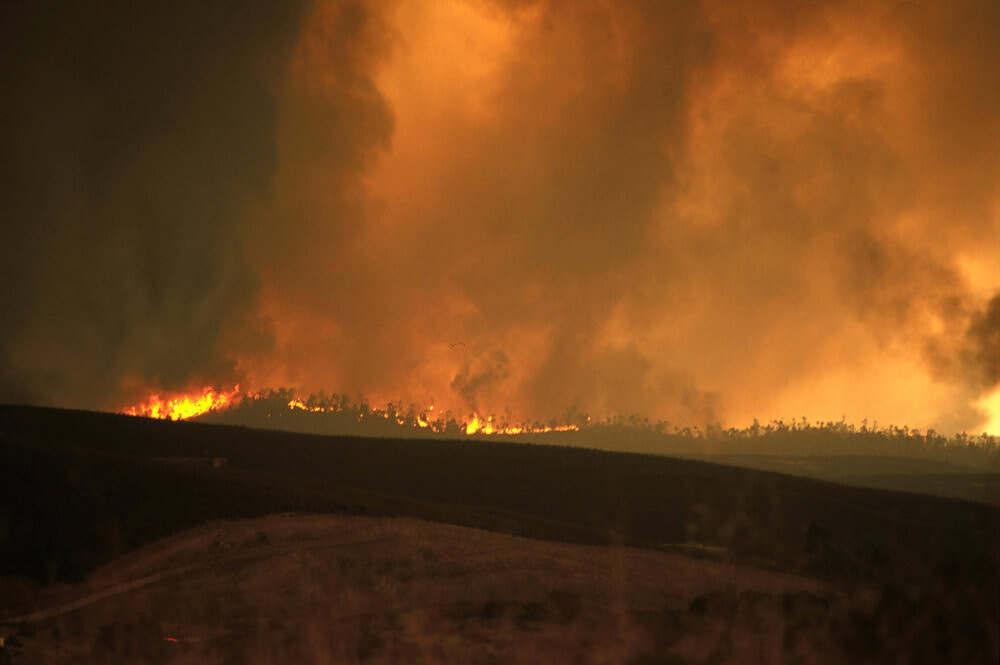
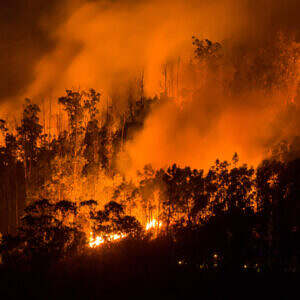
This natural world of Monchique was designated a nature reserve before 2000 due to its diversity of flora and fauna under the protection of the EU. Today, we can see what this protection is worth in the Natura 2000 system (No. 00037). The ICNF (Institute for Nature Conservation and Forests), which is also responsible for protecting the forest, has instead joined forces with Navigator and allowed the destruction to take place. In the district of Monchique, the natural forest should never have been cleared and planted with eucalyptus trees. The result was five major forest fires in 1991, 2003, 2004, 2016 and 2018. And I am only mentioning forest fires that destroyed at least 10,000 hectares of forest, woodland and traditional agriculture. Not to mention hundreds of homes and livelihoods.
This is precisely why The Navigator Company SA now has the dubious honour of receiving a cheap (low-interest) loan from the EU bank for the modernisation of its paper mills, under the guise of early climate neutrality. Greenwashing? If the bankers in Luxembourg and politicians in Brussels knew exactly what was happening in distant Portugal, how the victims of the forest fires have lost all their possessions and now also their trust in the EU, the EIB would be better off investing its money in sustainable forestry. Because there are also projects like this in Portugal; we just need to do a little research and we would immediately have a real point of contact: the Alliance for the Indigenous Forest, based in Porto. https://florestautoctone.webnode.pt/
 That’s exactly what I’ll be writing about next week: the magic of the natural forest. There are still a few spots in Portugal that haven’t burned down yet, because natural forests retain their moisture and are difficult to ignite. This native forest is no good for financial speculators; it’s a good example of how to preserve Portugal’s natural heritage.
One last question. Why does paper still have to be made from eucalyptus? There is so much unused, barely recycled wastepaper in Portugal and the rest of Europe. Recycled paper costs twice as much in Portugal as it does in Germany, Sweden, Scotland and other countries in northern Europe. It is the Navigator Company’s own business model that is hampering its economic growth. This is because demand for recycled paper is artificially constrained by a lack of domestic supply. Ask the management of the American multinational Staples about recycled office paper from Navigator. Their answer will certainly be interesting…