 Eco123 Revista da Economia e Ecologia

Avocado, the superfruit. For producers, the selling price per kilogram of avocados is between €1.50 and €3. This is in complete contrast to the price per kilogram of oranges, where the price for producers ranges between 50 cents and less than €1. Such a difference in prices awakens a farmer’s capitalist spirit, and it is clear what he will choose to grow.
It was near Bensafrim in the district of Lagos that I happened to witness an excavator destroying a forest of umbrella pines so that young avocado trees could be planted there shortly afterwards in a monoculture covering more than 150 hectares. When a water-intensive fruit is to be grown on a hundred hectares of land, the farmer must first consult the APA (Agencia Portuguesa do Ambiente – Portuguese Environment Agency). The planting procedure requires drilling, and the use of groundwater for irrigation. And the APA said NO. But the owners of the land were not interested in that at all. They presented the authority with a fait accompli. With a deafening noise, lumberjacks cut the 150-year-old umbrella pines with their chainsaws into two-metre-long logs, so that these could later be transported by truck to the sawmill, where they would be turned into formwork for the concreting of high-rise buildings. Shortly before I was chased away, I counted the annual rings of one of the trees to find out its age. The excavator tore the roots of the trees out of the ground. That was in April 2013. It was all about money. And, when it comes to money, most people show no mercy. In such cases, the forest has to go. And trees are a source of income, so that when an opportunity like this presents itself…
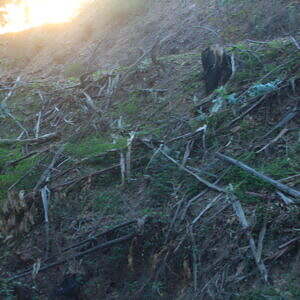 A few days earlier, I had been walking through Monchique and had seen Brazilian loggers cutting down a eucalyptus forest near the convent, so that the trunks could be used by the Navigator Company to make paper. The lorry was already waiting, with its engine running, for its cargo, which a crane then hoisted onto the loading platform: 30 tons of wood worth around €1,200. The forest owner still had to pay for transport and the loggers. In fact, there wasn’t much left after eucalyptus trees had been sucking the water out of the soil for eight years, growing so fast that you could almost see the trunks shooting out of the ground. Today, you still get €23 per ton for eucalyptus wood.
Anyone who invests money in monocultures must have skipped maths lessons at school. Only those who can’t do maths invest in eucalyptus. Because those who can do maths work sustainably with nature and not against it. After all, the water in the soil is the most important resource for forestry and agriculture. And then there’s the question of time. Time is long-lasting and cannot be described in terms of a single year. The soil, the land, will still need to be cultivated by the next generation. But what will our children and grandchildren do without water in the soil?
Years earlier, it must have been in the spring of 2008, I observed a team of professional tree planters in the district of Castro Marim, a few kilometres from the village of Furnazinhas, mostly women planting carob trees in the dry earth, one 15-centimetre-long seedling every five metres. When I passed by the sloping banks of the Foupana River again a year later, the 15-centimetre-tall seedlings had grown to a height of 20 centimetres, and it was only twelve years later, in 2021, that the seedlings had become small trees, two and a half metres tall, with the first pods on their branches. How slowly the earth turned…
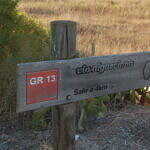 I used to enjoy hiking along the medieval trail now known as the Via Algarviana (GR 13), the ancient pilgrimage route to the southwestern cape of Europe, which today is between 300 and 330 km long and, in the fourth century, was almost 1,000 km longer because it came from Valencia in Spain, reached Portugal in Mértola in the Alentejo, turned south and stopped in Alcoutim, then led across the kingdom of Algarve to the end of the world. I had all the time in the world to complete my hike and was able to study the various native tree species at my leisure, observing their growth, their characteristics and their seeds and fruits. I gained a deep reverence for nature and its laws in the four seasons.
 Every spring, I enjoyed taking the bus over the 16 kilometres between Caldas de Monchique and Portimão, then travelling 150 kilometres by train via Faro to Vila Real de Santo António, and finally taking the bus over another 40 kilometres along the Guadiana River up to Alcoutim, where my 15-day hike along the Via Algarviana would begin. My hiking groups often met at the hostel on the Guadiana. At some point, I had got hold of an old military map, framed the different sections and hung them in the hallway of the house where I lived so that I could keep track of everything.
  Over time, I changed the route a little, avoiding tarmac roads and walking through small surviving forests that were more than 1,000 years old.There were still a few very old cork oaks remaining, two thousand years old, such as the one in Corte Grande near Monchique, which had been planted in Roman times and had witnessed the lives of different generations of people over the centuries, from the Moors, who conquered the south in the eighth century, to the next generations of Christians, who inherited their agricultural practices, which I can still see today in Salir when I walk through there. It was only with the irrigation technology developed through the Moorish noria that traditional agriculture became possible and the hinterland of the Algarve began to develop and prosper.
One day, I met the goatherd Idálio Martins Ramos, who, at a very young age, had migrated with his first goats from Portela da Nave to Benafim and then back again. Whenever I met him, he would tell me about his ideas for developing a dairy and, in particular, about the products, the fresh cheese, that he made. Today, he has five employees, has been legalised through an EU support programme, and I am one of his regular customers – one of many. Every Tuesday, I drive my electric car the 66 kilometres from Monchique to Salir and buy fresh goat’s milk once a week with my five-litre milk can. Why? Because the milk from his 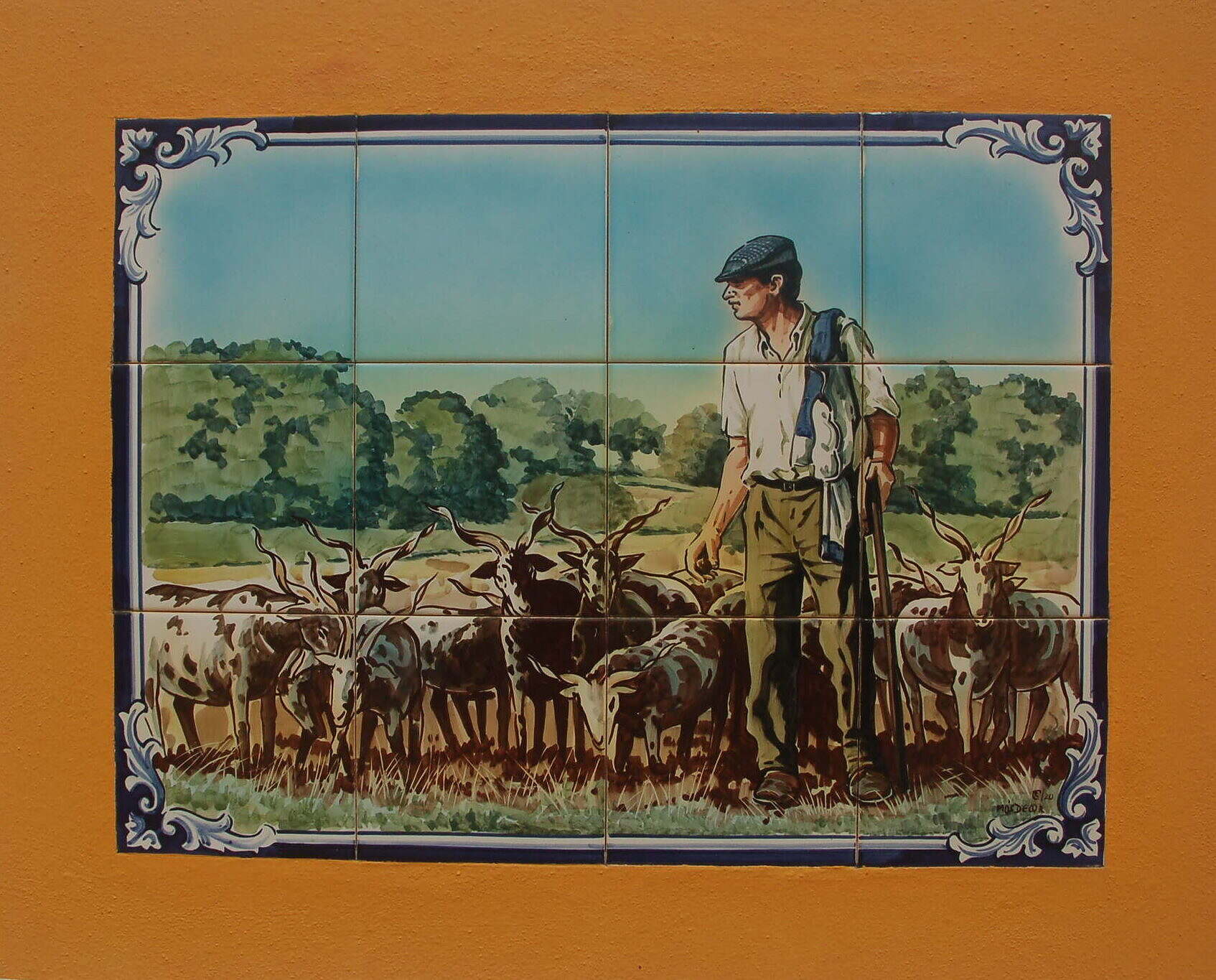 goats is unique and I don’t leave any rubbish behind, as I don’t have any packaging to throw away. And I always buy a goat’s cheese as well. Delicious! We all want to live in a climate-neutral way, don’t we? Let’s start with the question of rubbish. Quite simply, let’s avoid it. Do you know how much rubbish the average Portuguese citizen produces per year? According to the latest statistics (2024), it’s exactly 519 kilograms. The mountains of rubbish are getting bigger and bigger.
Fever.
Every year in spring, I would put on my walking boots, pack my rucksack and disappear for 15 days. My cross-country walks with hiking groups used to begin in May, then in April, and, from 2020 onwards, in March. Why? Because it was getting hotter every year. While it was still quite pleasant to hike in May at the beginning of the new millennium, by 2012 it was already so hot that the sun almost gave me heatstroke. So, in 2013, I began my walks in April, and, in 2018, I set off even earlier, in March. The summers were getting longer and the winters shorter. It was getting hotter in southern Europe, and I longed for clouds in the sky and sometimes even rain. Because the rivers I crossed, the Foupana and the Odeleite, were getting narrower and narrower, and gradually the Foupana ran out of water altogether and dried up in certain places. Yet, swimming in the river, which was absolutely clean, was a must for me. I took off my clothes and went swimming naked before climbing back up the slope on the other side, fully clothed, and spotting the village of Furnazinhas in the distance. There was not a soul to be seen down there by the river. I was alone in nature with the animals, with the wild boars, the foxes and mongooses, as well as with the fish, when the river still had water.
Dona Olívia, who was already well over 80 years old at the time, sometimes waited for us at Casa do Lavrador, a very beautiful hostel, always with our dinner ready. The next day, I would continue my hike to Vaqueiros, then up to Cachopo and Feiteira, and from there to Barranco do Velho. In the Serra de Caldeirão, I met shepherds and their animals, as well as farmers who still cultivated their land with hoes: wine, potatoes and, above all, lots of vegetables: beans and onions, cabbage and chickpeas. The path through the hinterland was like a cure for me and my hiking groups. I felt life pulsing through my veins when I arrived at my hostel in the evening after walking 25 kilometres or more and was given a friendly welcome. Life in nature promised me true health…

Insofar as nature was intact. From Silves onwards, I was overcome by a sense of desolation. Industrial eucalyptus trees grew in the grey soil. Since the Via Algarviana was being exploited for tourism, there was no mention of the industrial trees in any of the guidebooks. The other hikers trudged along the grey-coloured hiking trails as if they were walking through black icing sugar. There had been fires here again, and also in Monchique and Marmelete and on the way to Lagos and Bensafrim. So, I looked for alternative routes, away from the industrial forests, and for other connections to Aljezur and Arrifana, Bordeira and Carrapateira, Vila do Bispo – avoiding the burnt paths and areas. This sparked my interest in getting to know other forest lovers, and, in 2018, I came across Aliança pela Floresta Autóctone, an association based in Porto, with members throughout Portugal. I took the train and headed north to prepare for an interview. That’s how I met José Carlos Marques, a long-time reader of ECO123. José was a few years older than me and very energetic. He also went hiking…
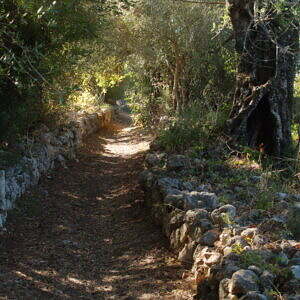
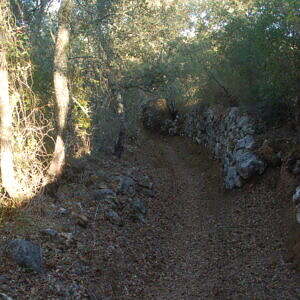
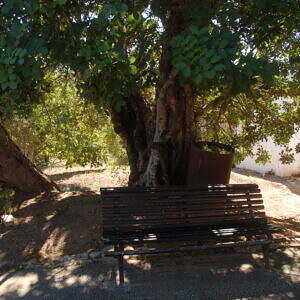
In the Algarve, I took the path down from the mountains and was on my way to Salir, a village below Barranco do Velho, which in turn nestled alongside National Road 2. Shortly before Salir, the hiking trail led to a very old sunken path bordered by two natural dry-stone walls, with centuries-old olive trees, carob trees, almond trees and a few ancient cork-oaks standing to the right and left. I picked up my camera, stopped and looked for the right position to capture these ancient creatures. They all seemed to date back to a time when the Moors had shaped the agriculture here. It was the heyday of Moorish rule over the Algarve.
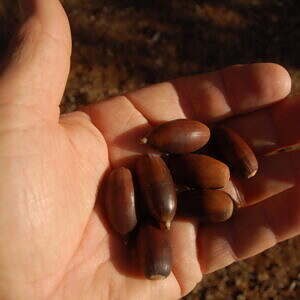
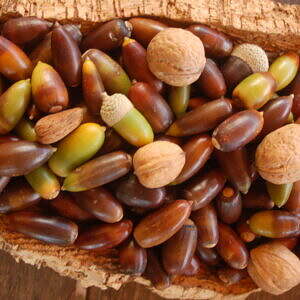
 These trees could have been more than a thousand years old, so gnarled were they as they stood before me, grown over many centuries, pruned and grafted in such a way that both green and black olives hung from a single olive tree. It was late in the year, and I was hiking for the first time in autumn… In October, I stuffed acorns into my pockets, acorns from oak trees, not cork-oaks, because I was looking for the Monchique oak, known as quercus canariensis in Latin. After all the forest fires, there were still four of these trees left in Monchique, which I had located, so it was quite possible that there were a few more trees in the district of Loulé and also in Silves, and diversity, as we know, begins with seeds… I slowly began to take an interest in botany. I was captivated by these trees in Salir: they were beautiful in all their diversity. There were also some fig trees, a few mulberry and walnut trees, each of which had been planted ages ago near streams and Moorish wells. The Via Algarviana hiking trail led through a botanical gallery that would make any nature lover feel euphoric. And autumn was exactly the time when nuts were harvested. I lingered for a long time and didn’t arrive at my hostel until late evening. I didn’t need supper that day…

To be continued next week on Saturday…